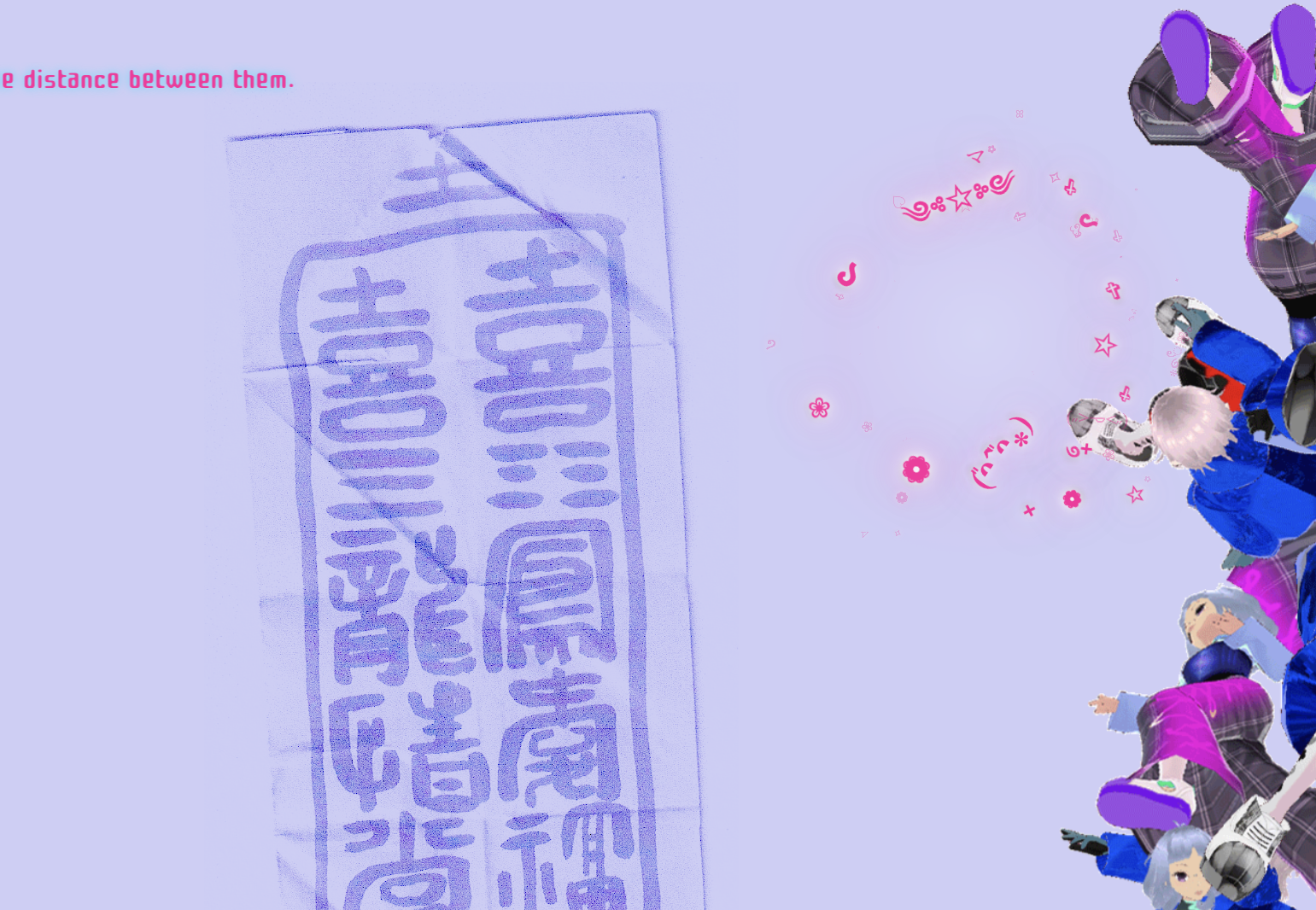
Bea Xu on Twin Flames, Digital Storytelling and the Illusion of Choice
Wed 25 Nov 2026As part of out SERVER talks programme for AND Festival 2026, artist Bea Xu presented a part lecture-performance, part visual teaser of The Dynamo is Loading Exactly As Intended. To celebrate its release this month, we caught up with Bea to explore the themes of this biopunk love story adapted into the digital realm.
What drew you to the online phenomenon of Twin Flames as a framework to explore human attachment and agency?
To know your Twin Flame is to experience a uniquely expedited process of spiritual growth through the agonising push and pulls of that one fated relationship dynamic in the role of either the ‘Runner’ or the ‘Chaser’, which is already ordained by a 5D version of the two of you united as one soul before either of you incarnated on Earth.
I think I needed to make a work about this phenomenon because it’s an experience that I’ve lived through personally and it just so happened that in the process of doing so, I created something that explores attachment and agency because those two themes are inextricable from the journey you embark on when you encounter this relationship. The desire to make a piece of work that meditates on this theme has been in the making for a few years now. Nothing from the worlds of art or psychotherapy, both of which I practice in, seems to have really grappled with it in a way that feels satisfying to me.
I feel like it’s one of those experiences where iykyk… And those who *know* will be hungry to speak more about the experience with someone else who gets it. At this point, I’m still not sure that the entire edifice of it is real – or if it is, to what extent it really matters. But like many phenomena in the realms of magic and mysticism, believing in the thing is a choice that then shifts your entire reality through the prism of that particular schematic. I don’t want to demystify the ‘thing’ too much as I believe that it unfolds naturally through the work – suffice to say that the phenomena can be interpreted and even problematised through multiple frameworks (Attachment theory, vampirism, geotrauma, neurochemical terrorism and the love industrial complex, for example). Perhaps one of the underlying messages of the journey is: no matter your level of attachment to the Other, things will only shift when you choose differently.
The research and development for Dynamo began over a year ago, when I was building and illustrating the components of a set of physical installations that would later become the analogue prefiguration for the website, exhibited at Bolding gallery for Sweet Cautery this April. I was working on them during a residency at Organhaus in Chongqing, which also culminated in a lecture performance called Do Not Love (the first iteration of the presentation I later gave for SERVER at AND Festival 2026). Following lecture performances at both Organhaus and Bolding, I had members of the audience approach me directly with a glint in their eye, telling me they believed they were in a Twin Flame dyad of their own. There’s a devastating intimacy that this topic seems to open up between people. My own experience was so all-consuming and mind-altering when I was really in the throes of it; I so desperately wished to have my experiences validated by those of someone else in order to make sense of what was happening to me.
What interests you about the internet as a space where mythologies around love and identity can be created?
While the first time I ever came across the term ‘Twin Flame’ was in an IRL women’s circle (into which ideas on the subject may have carried over from the New Age spiritual leader Elizabeth Claire Prophet), all of the subsequent, obsessive research I was digging up about the phenomena was very online because I had few other resources to turn to. I’ve never come across any conclusive literature on the subject – only snippets of online hearsay from anonymous testimonials or grifters positioning themselves as gurus on the topic… but actually, I feel like the user-generated nature of modern lore about Twin Flames is part of its appeal and potency.
That the internet is a repository for modern, translocal folklore isn’t a particularly groundbreaking observation for me to make at this point in time. But the beauty of folklore being shaped and morphed online is that internet platforms, ideally, allow for an immediacy of discussion around these mythologies that allow sub-denominations, forking paths and non-canonical beliefs to diverge away from any orthodox belief about love and identity. Everyone can lay claim to expanding the territory of the Twin Flame phenomenon through their confession – but it is up to you to siphon through all the material out there to decide which denomination of belief you want to adopt as your own.
I first began coming of age into subculture in the early 00s through a combination of Dollzmania, Livejournal communities and MSN Groups – and later Myspace (this platform gets rebooted in the near-future world of Dynamo too). But the internet was very different back then and nowadays online cults like Twin Flame Universe will predate on lonely spiritually-open people who are desperate to find a life partner by offering to be an authority on what they are going through in exchange for their money and compliance. There was a 2023 Netflix documentary made about this cult called Escaping Twin Flames – after which Twin Flames as a phenomenon became a little bit more understood in the mainstream.
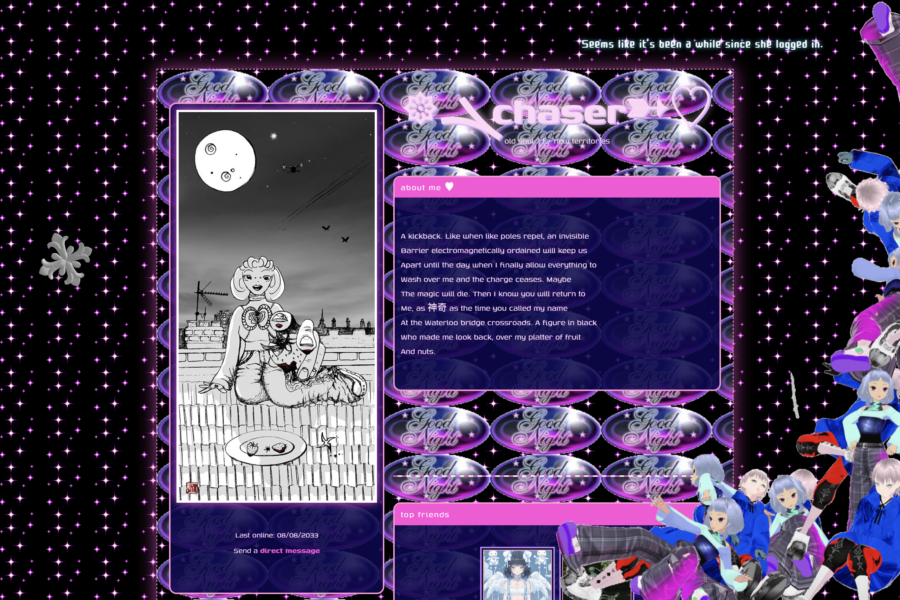
I hope that rather than proscribing a fixed set of expectations, Dynamo complicates the motivations and forces at work behind this specific myth. Maybe my work in website form will end up contributing to the trove of online folklore for other Twins to turn to if they need some guidance or validation about their experiences in the future.
Why did the format of interactive webtoons feel appropriate for exploring these themes?
I spent most of 2025 ‘developing my creative practice’ with a grant from Arts Council England by reading Korean webtoons; researching precursors to Chinese manhua; receiving mentorship from writer Jamie Sutcliffe about merging my interests in Japanese manga, Taoist sigil making and asemic calligraphy into a new kind of text-cum-graphic format; and doing an RCA short course on ‘the Graphic Novel and Visual Storytelling’.
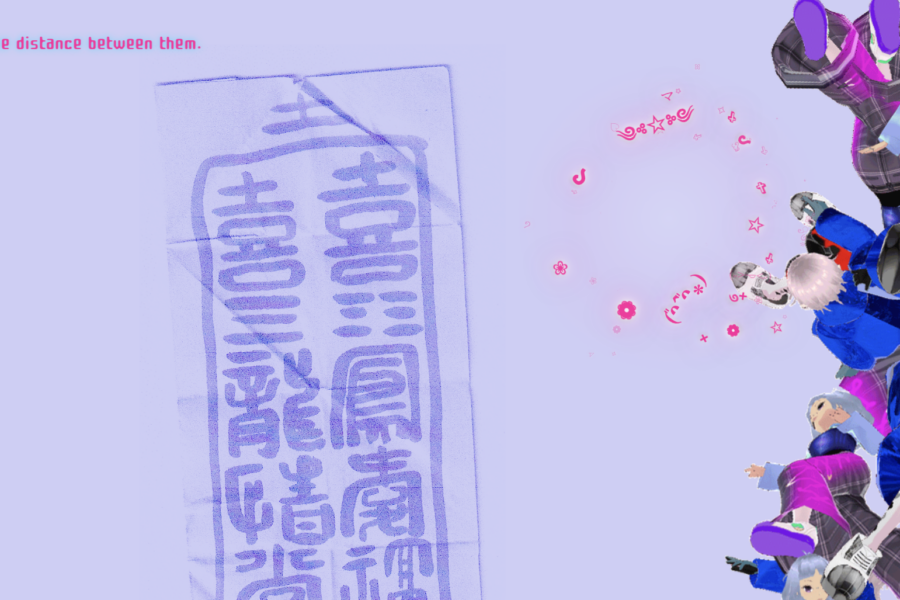
My practice up until that point had been more live art and installation focussed and I was leaning into this mark-making entanglement for the first time because I wanted to make work that was more permanent and distributable. I felt that the graphic novel as a medium reflected the strange compositions of a Taoist fu talisman; as a study into the semiotics of image versus text and the spell-making potential of deconstructed and recombined glyphs.
I invited Zaiba Jabbar of Hervisions to the Bolding show and she enjoyed the theme and drawings so much that she commissioned me to make a digital version of the work.
Deciding to build a web-based commission was extremely challenging as someone who had never made interactive digital art before. At a certain point I made the irreversible decision to do the brunt of the web development myself and build the story with my scanned illustrations on Twine (cue multiple crashouts over the months and a mammoth amount of tech support from Oliver Smith). I had this initial idea where I wanted the reader to be able to select different sequences of the same set of image frames within a 2D simulation of a 4D toroidal grid and infer radically different timelines from them – something inspired by the Kuleshov effect in cinema on the one hand and these geometric torus games on the other. But I quickly discovered the drawings I had were too contextually-specific for that idea to work. Instead, I decided to let the story tell itself in its original sequence, with hyperlinks that nonetheless connected disparate pockets of the narrative. I transitioned into a format that placed more of an emphasis on text than I had originally planned and the work began to resemble more of an illustrated choose-your-own-adventure hypertext – which brought me back to my original goal of creating a new kind of webtoon.
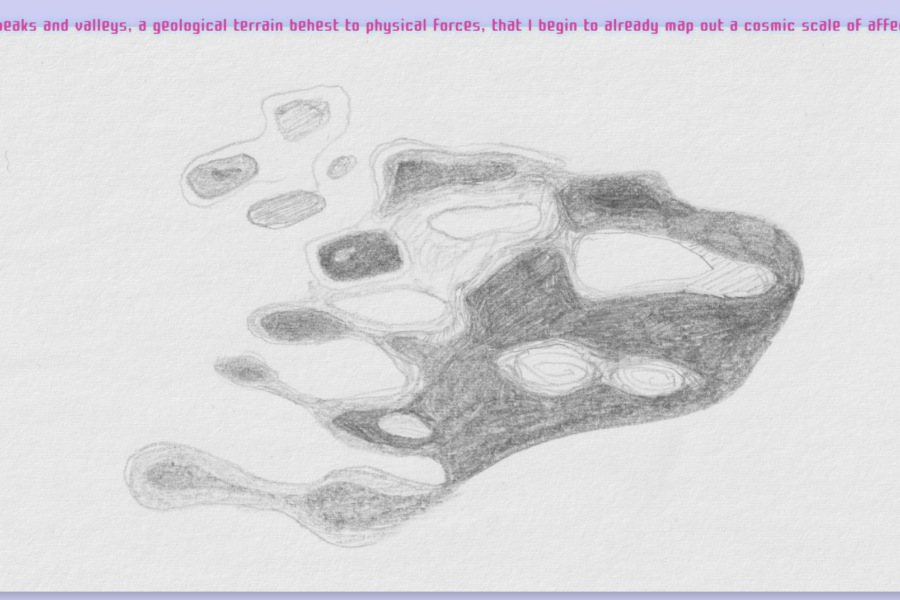
How do the elements of non-linear storytelling and interactivity in the work shape the reader/player’s experience?
I knew from the very beginning that I really wanted to convey different orders of dimension through visual layers on the screen, where the higher order and upper visual layer would contain this omniscient subjectivity that could instruct and manipulate the narrative, via the reader, down below.
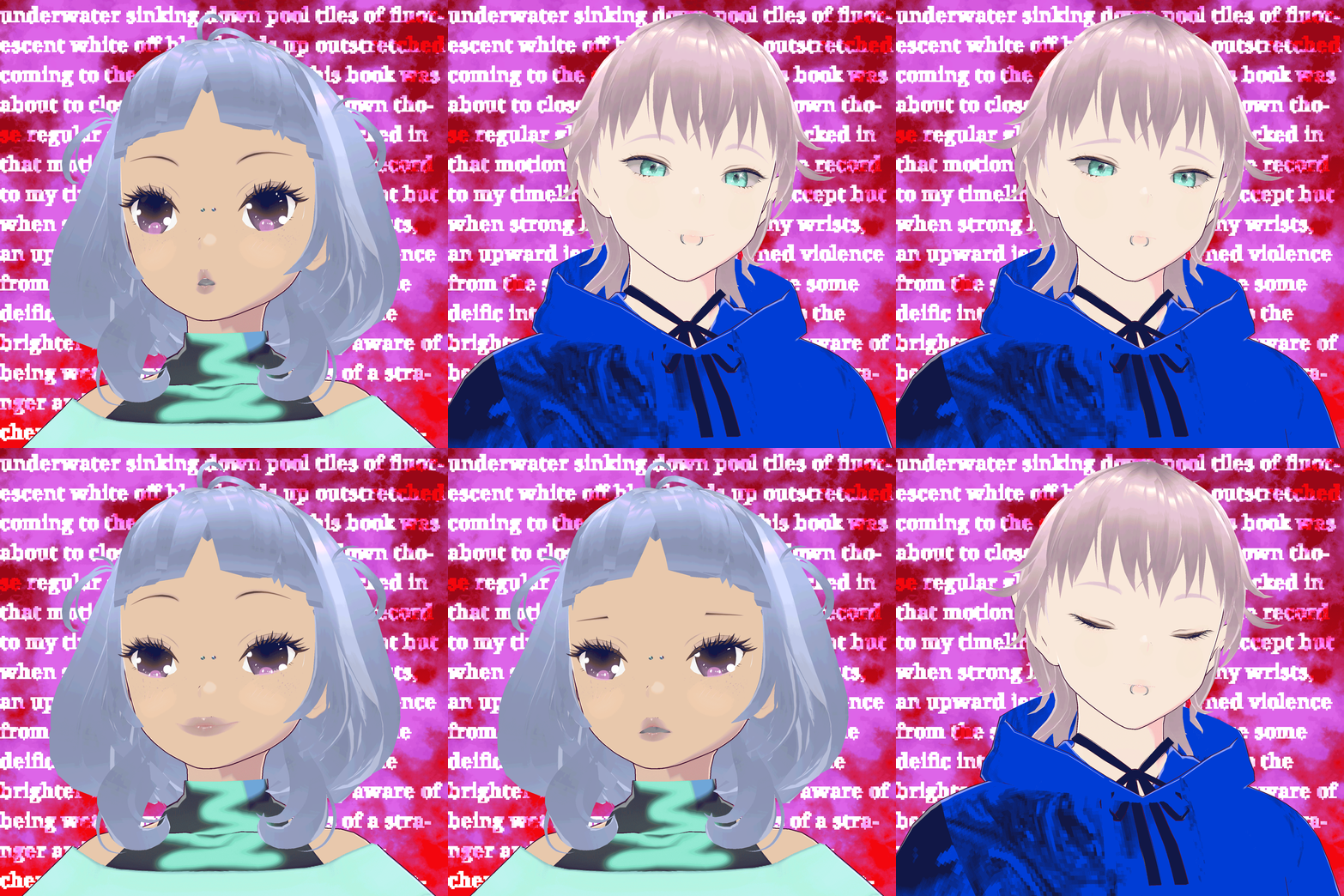
If our ordinary 3D reality (in which the two Twin Flame counterparts, the Runner and the Chaser exist) would be flattened into 2-dimensional pencil illustrations, then the 5D realm of the Primordial Human (where the Twins are conjoined, centipede-like throughout a spacetime configuration of their respective lifetimes) could plausibly raise that level of spectacle to a moving 3-dimensional gif. I’m not a 3D designer but Oliver had used VRoid Studio to design a cute, chibi-like character for a previous performance work 三三三 (sān sān sān) I’d toured between 2025-2026 in Berlin and China, so it made aesthetic sense to make the gifs out of composited VRoid avatar snapshots, stop-motion style.
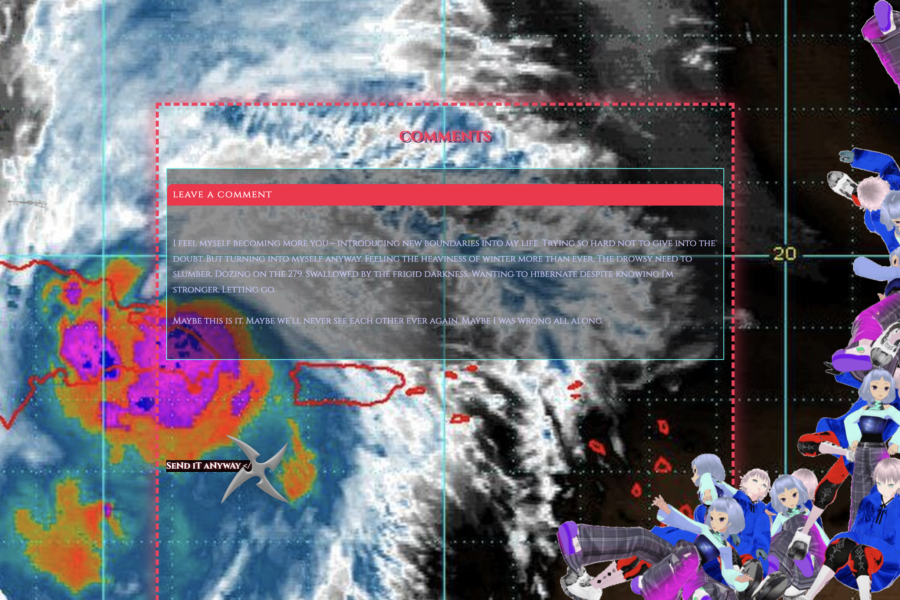
Then, as agentic artefacts from the 5D plane that are gifted to the twins from their conjoined Self, there are four ‘operational’ objects which play an important conceptual role in the story. Reverse-engineered from 3D printed components of the work’s preceding physical installation (and then animated and made interactive by Joaquina Salgado): the bramble, key, shuriken and cross fluery help the Runner and the Chaser (selected by you, as the reader) to activate choices through the story according to the polarities of attraction and repulsion they/you feel towards your twin.
These polarities pulsate as an underlying dynamic frequency to the partnership, compared by the Primordial Human in one of its lofty scrolling marquee commentaries to a magnetic field. Biu Rainey, the guest writer for some of the Runner, has since observed how her looping navigational movements through the text as a reader simulated a feeling of moving through this field. This was made possible through the non-linearity of the hyperlinked pathways through the work; where some choices give you the opportunity (or the frustration) of looping back to the start or else a previous memory – while other decisions may catapult you forward by an indeterminate amount of time, out of your reverie, into an equally dreamy future-present.
Ultimately, making a choice – or at least an illusion of choice – is a key tenet to what I am exploring with Dynamo. To what extent is a relational decision born out of actual free will, and to what extent is there a deterministic element to the repetition compulsions we make due to our attachment traumas and early relational conditioning?
The Dynamo is Loading Exactly As Intended is now live on the Hervisions portal with curatorial statement and via direct link.
The Dynamo is Loading Exactly As Intended
Concept, illustration, writing, voice & development by Bea Xu
Development support & sound design by Oliver Smith
Additional development by Joaquina Salgado
Guest writing by Biu Rainey
Featuring music by ikea.customer_services
Commissioned by Hervisions supported by Arts Council England